Blind organists,
and the challenges of church music-making
|
|||||||||
|
|
|||||||||
|
|
|
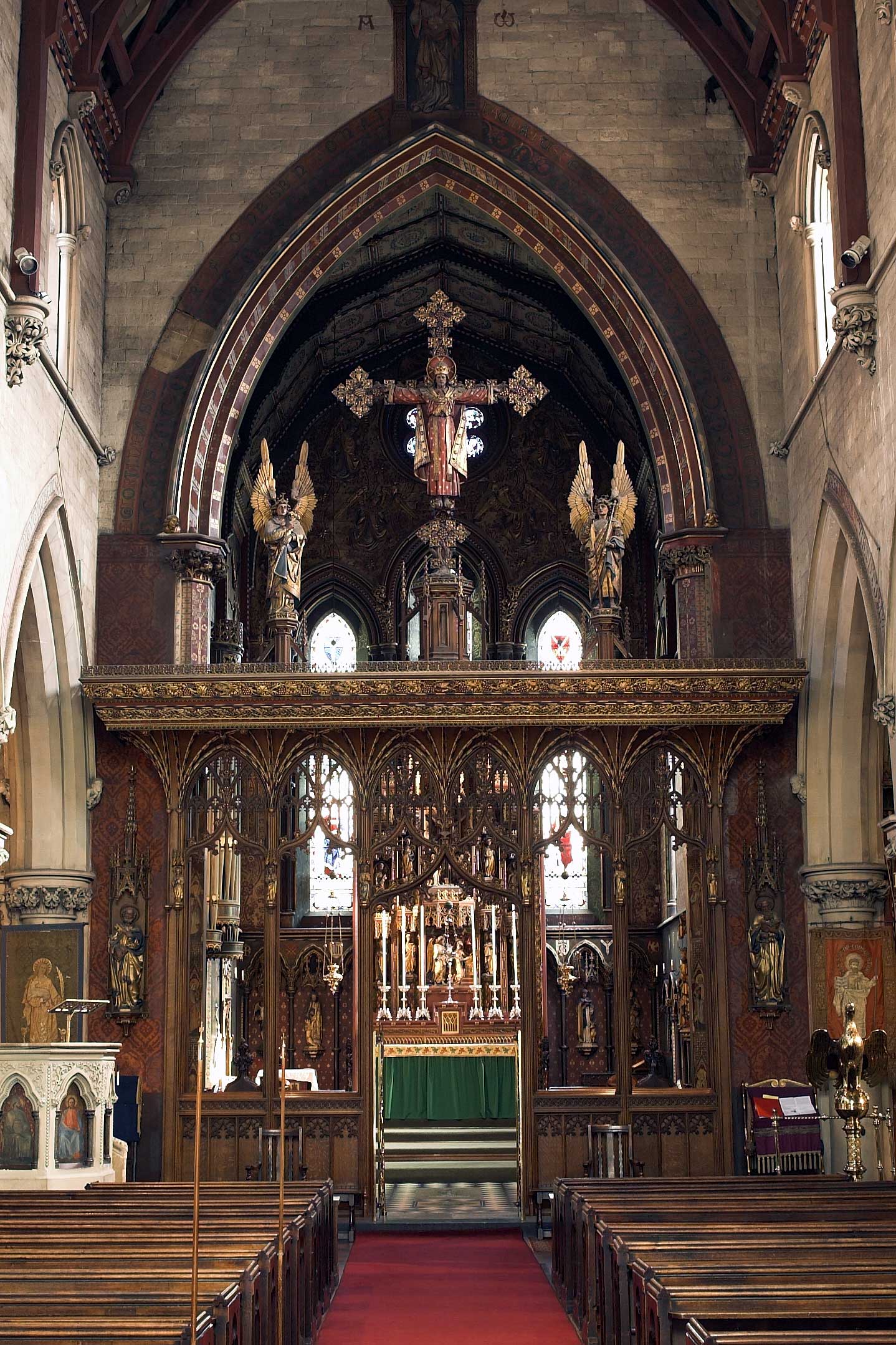
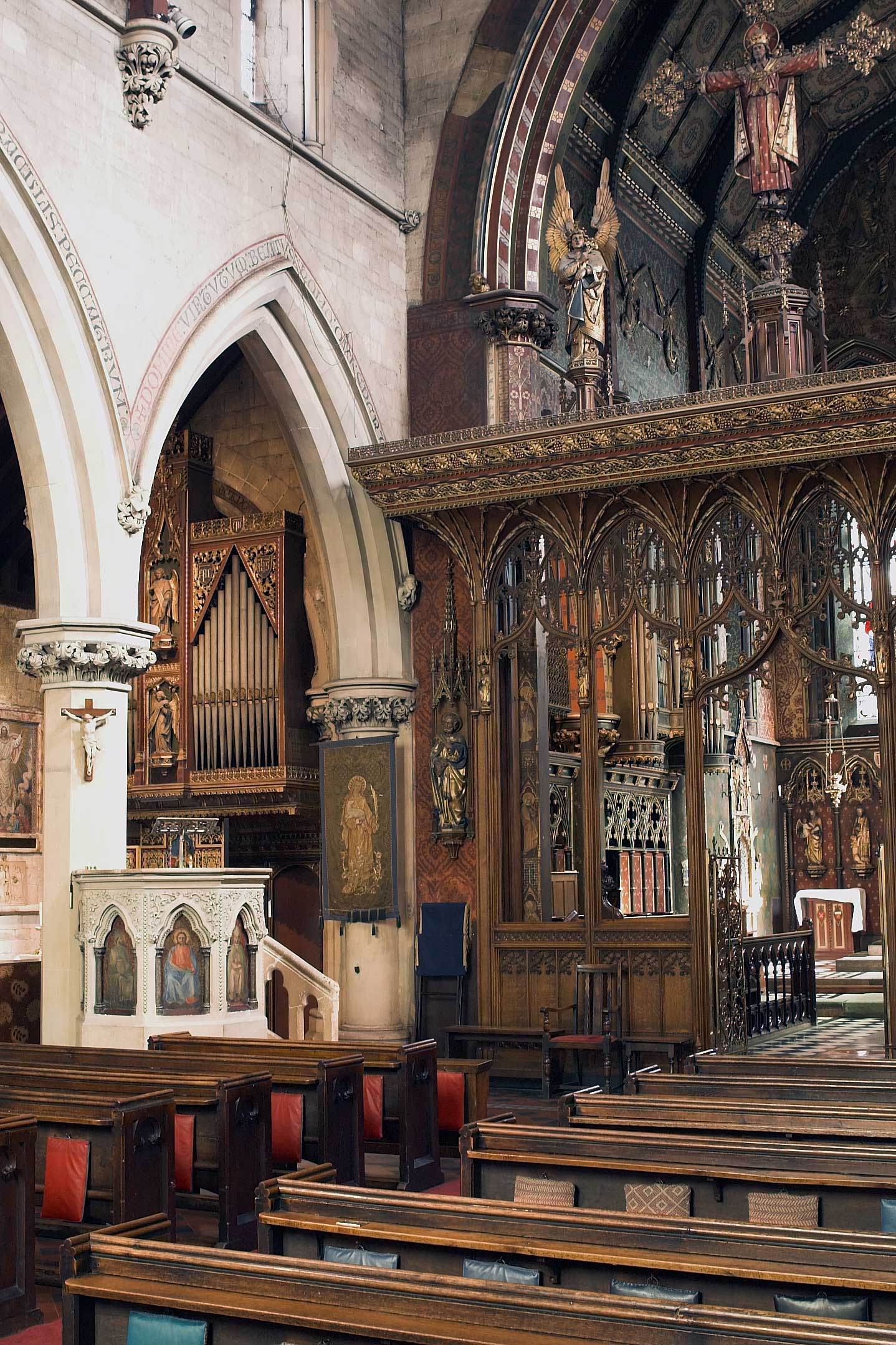
St Barnabas, Pimlico
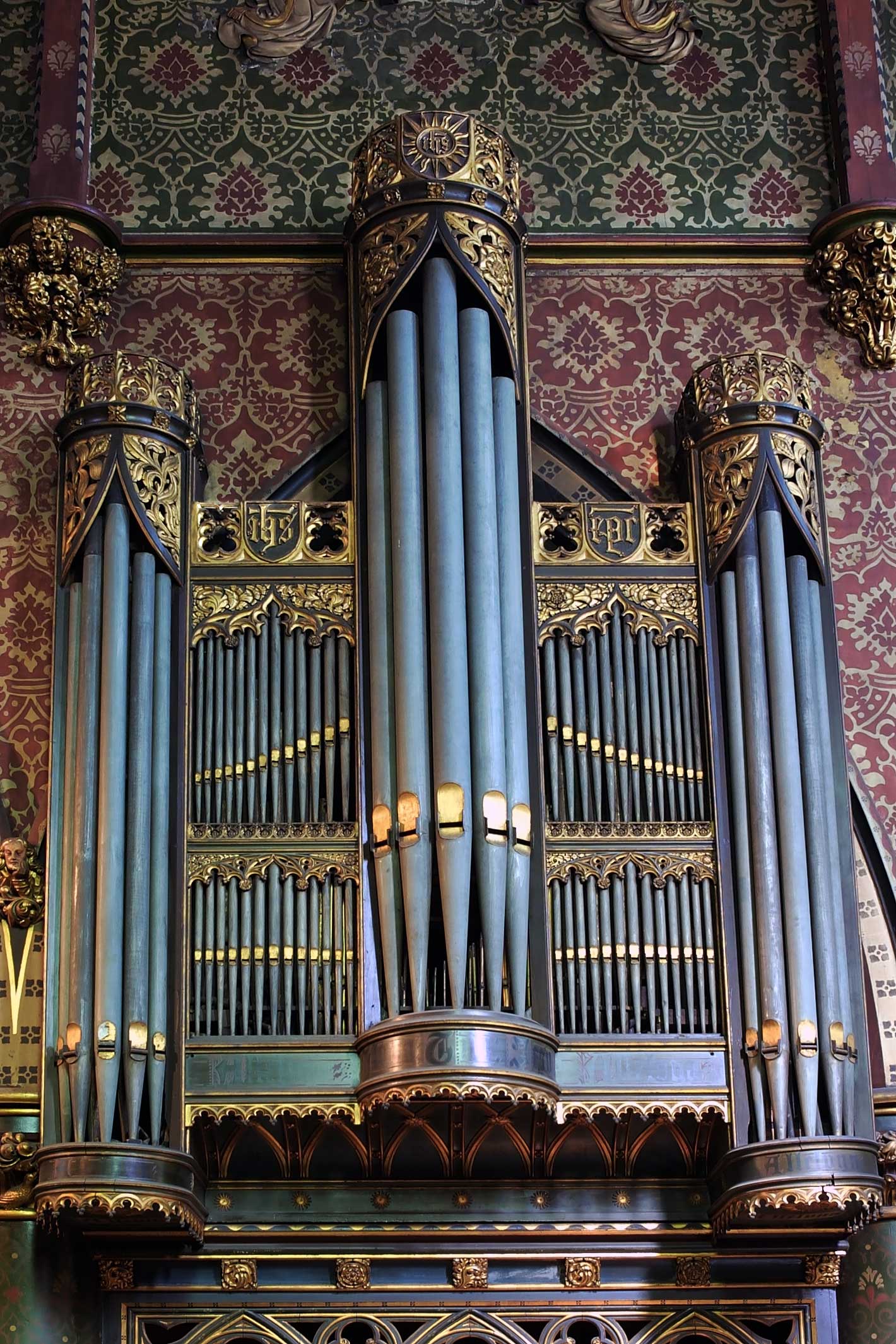
Chancel organ case
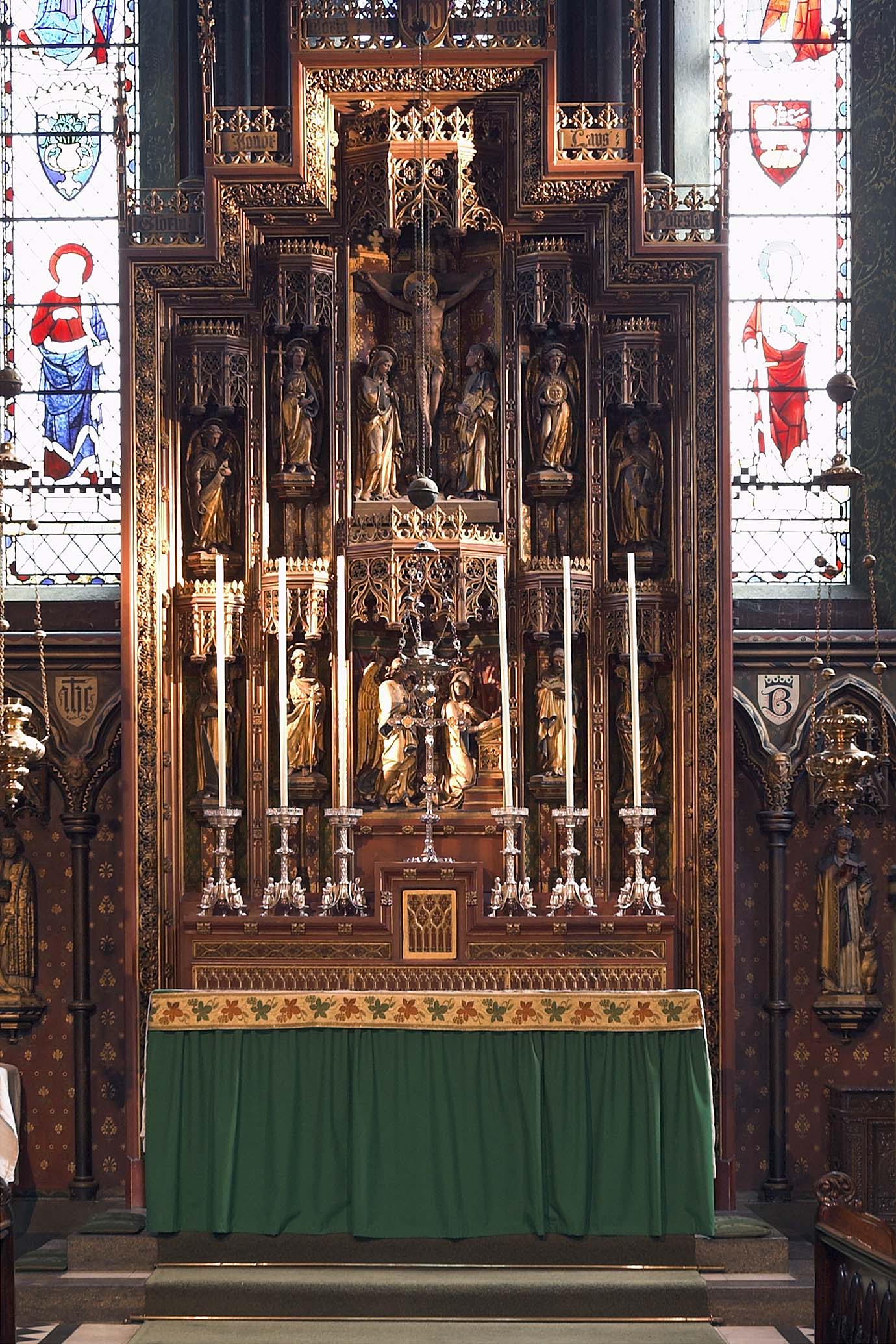
High altar
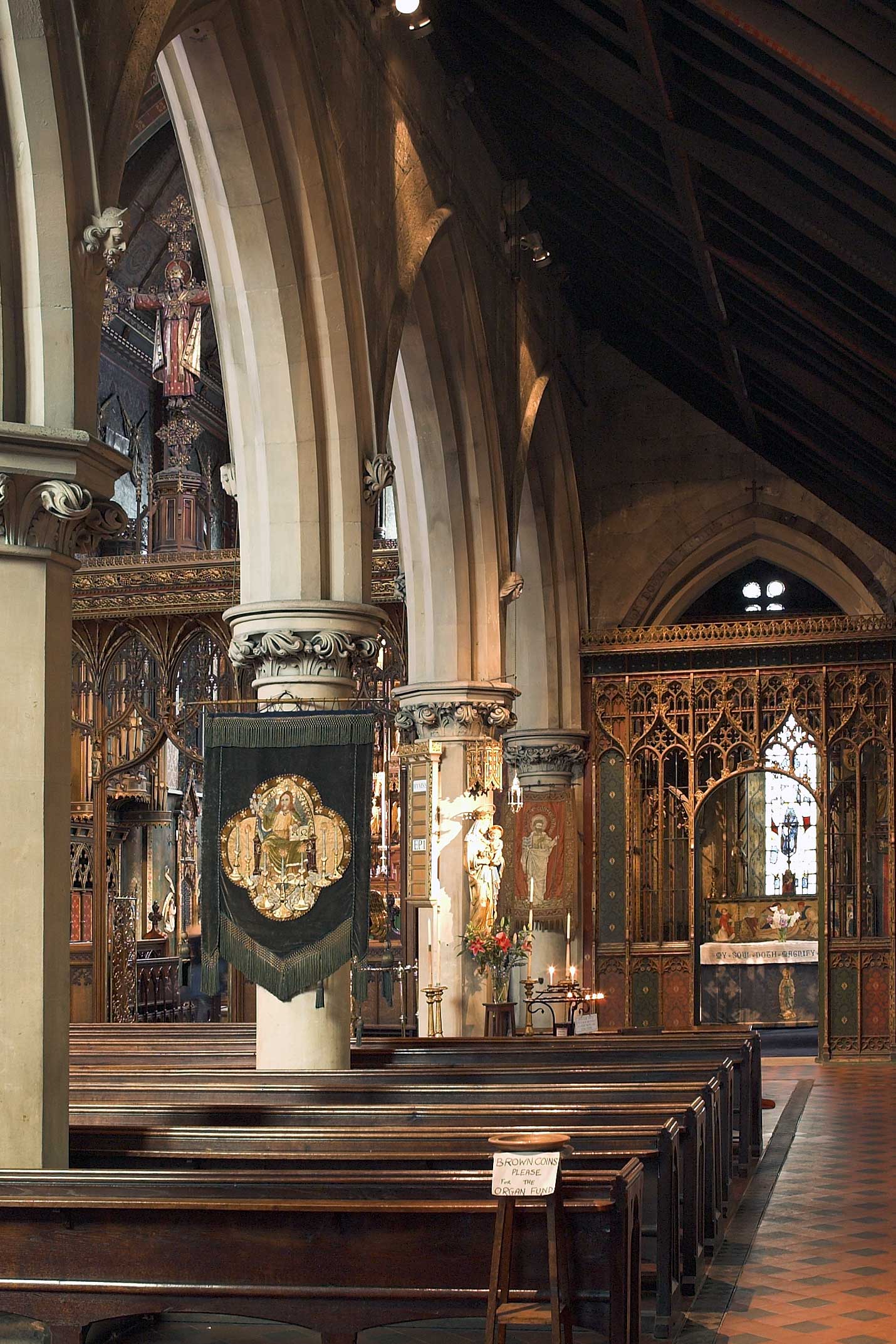
South aisle, looking east
The organ
Chancel screen |
The church of St Barnabas Pimlico is located in St Barnabas Street, London SW1W 8PF. It is between Sloane Square and Victoria underground stations, and is served by bus routes 11, 44, 170 and 211. Bus route 137 passes a short walk away. I would be delighted to get comment, advice and reflections from other blind organists who have coped with the challenges of church music making. Several of my blind organist friends have found ways round the many hurdles by means of prodigious memory and ingenuity. It would be fascinating and instructive to learn their methods of approaching the work. Learning music by Fauré For a big confirmation service held in 2004 at St Barnabas Pimlico, Helen Vickery brought a girls’ choir from Francis Holland School to sing the Mass setting and motet. The Messe basse of Fauré was chosen, which set me a new challenge as accompanist. It is not available in England in Braille, so I asked my Dutch friend, Gerco Schaap, if he could buy it for me from the Dutch Braille printing organisation, in whose catalogue the Fauré appears. However, it emerged that they no longer sell Braille music to overseas customers. I then turned to my Danish Braille catalogue, where I also found the Messe basse available for sale. On contacting them it transpired that they too prefer only to lend, not sell Braille music. Time was getting short, so the kind lady in Denmark posted the Fauré to me, saying that we could discuss money later. The two slim Braille pamphlets duly arrived: the estimated cost to buy them is 230 Euros – approx. £150! I started learning the Fauré accompaniments as soon as my Widor Symphony No.7 performance was past. It did not take long to memorise them, especially since it is such gorgeous music. Further Fauré complications Helen Vickery suggested “Tantum ergo” by Fauré as the motet. This one was not available in Braille anywhere. We arranged for Helen to record the accompaniment on piano for me, describing note values and other details where necessary. The recording was delivered via the Vicar, and I got down to learning it quickly. Despite a superb job, there were inevitably some unclear details, as happens when this sort of project is undertaken at a distance. I exchanged some complicated E-mail messages with Helen, asking about such things as the duration of the C natural in the Bass of bar 9, and so on. Oscar Rook lent me some CD’s of the Fauré Tantum ergo and Messe basse, which proved invaluable for checking what I had learnt. Enriching our liturgical music Our Vicar wanted to introduce Responsorial Psalms into our Sunday 9.30 am liturgy at St. Barnabas. Psalm playing was an unknown field to me, and I wondered how I would manage. The Vicar decided to try out our first Responsorial Psalm at the big Confirmation service, before incorporating them into our weekly liturgy in 2005. He offered to guide me through any tricky points, thus he sang through a Responsorial Psalm for me, describing how it worked with Cantor and congregation. Likewise, he introduced Plainsong Eastertide Alleluias before the Gospel, and similarly demonstrated how this works. Braille transcription I approached my friend, Ron Bayfield in Brighton, who has transcribed various musical items into Braille for me over recent years. I explained that the Responsorial Psalms in New English Hymnal are not available in Braille, and that we were soon going to incorporate them into our liturgy. Ron, who had just completed a big transcription for a blind Canadian organist, immediately agreed to Braille both words and music of these Psalms for me. We again had many phone and E-mail discussions about how in Braille to indicate “pointing” (the syllables where the singer changes note). Ron completed the job very speedily, and I proof-read the Braille. He then sent me a second, perfected Braille copy. It has been fascinating to see how these Psalms appear in Braille. Ron is able to utilise a Braille printer, which was bought at vast cost by the Sussex Province of Freemasons, to whom I made a token payment in gratitude. A question of coordination Finding it much harder to memorise words than music, I have developed a method of accompanying Psalm verses with my right hand and pedals, leaving my left hand free to follow the text. This is a technique which I also use in hymn playing: some tunes are more suited than others. For example, “Hereford”, to the hymn, “O thou who camest from above”, can be played entirely by right hand and pedals, since the Tenor and Soprano lines never diverge by more than an octave. Contrast this with a tune such as “Thornbury” (written by a previous Organist of St. Barnabas, Basil Harwood), which requires both hands almost throughout. Thus I admit that my observation of punctuation is likely to be far better in the former! Technology helps contact Technology has long been of great assistance to me. The player at St. Barnabas sits underneath part of the organ, and is shut away from the body of the church, making it utterly impossible to hear the singing and speech. Some years ago, my friend, Simon Gutteridge, installed a pair of microphones in the church, connected by long leads to a tape-deck beside the organ console. With a set of headphones, and the tape-deck on Record and Pause, this becomes a perfect sound relay system, allowing the Organist to hear how the instrument sounds in the body of the church, as well as giving me close contact with Priest and congregation. At present, my mikes hang on either side of the pulpit. Thus, when I wear my headphones, my ears are effectively beside the pulpit. (Little do the people sitting in that front pew realise that I can hear their every whisper!) Another problematic area for me at church is how to know when to start or stop improvising, at various junctures when organ music is required to “paper over the cracks”. With a friend's practical, generous help, we managed to tackle this problem. He said that he could obtain from America a remote-control vibrator, (no, don’t get too excited, this is rather like the vibrate mode on a mobile phone). After some stimulating experiment with the vibrator in various pockets, I concluded that it is best worn on my shirt collar, on the back of the neck, where its vibrations are unmistakeable and also rather therapeutic! In this way, the Vicar could press his remote control button, indicating to me that I should keep playing at the end of the Offertory hymn, or draw to a close when he was ready to continue with the Mass. However, the system was marred by intermittent blackouts, probably caused by stone pillars preventing the signal from reaching me. Subsequently, it was more practical to ask the cantor of the day to stay with me throughout the Mass and act as my lookout. Monthly Evensong and Benediction Another great challenge I embraced was to play for Solemn Evensong and Benediction. Our Vicar is in charge jointly of St. Barnabas Pimlico and St. Mary’s Bourne Street, and for two and a half years, the latter exported their Evensong and Benediction to St. Barnabas on the first Sun. of each month. I was very keen to have a try at playing for this complex liturgy. There are many Plainsong tones and chants to learn and accompany – Responses, Preces, Office Hymn, Psalm, Canticles, Antiphon to Our Lady, Adoremus/Alleluia. There is also much coordinated improvisation. For this occasion, a human look-out is essential. In retrospect, I feel that the Psalm presents the greatest challenge: my Braille reading speed is barely fast enough. Perhaps there is no substitute for memorising the words: what do other blind organists do? As I have explained, our Sunday morning liturgy did not include Psalms until January 2005, when we started incorporating the 13 Responsorial Psalms from the New English Hymnal. These became very familiar over the ensuing two and a half years. After much discussion, the cantors invested in copies of New English Praise. This provided us with another 15 or more Responsorial Psalms, which we started to incorporate in September 2007. I made a tape/CD on which I sang through all the Responsorial Psalms from New English Praise, and distributed copies to all cantors. This enabled them to learn and practise at home. I also offer “telephonic practices”, where I sit at my home piano, and the cantor sings down the phone! We can iron out many problems by means of such a disembodied rehearsal. My Organist friend, Stephen Jasper, impressed me with his method of setting Responsorial Psalm texts to Gregorian chant. We first tried this on St Barnabas Day, June 11th 2010. With much encouragement from the clergy, these Gregorian Responsorial Psalms have taken root, though not all the cantors are enthusiastic. For these Gregorian Psalms, I point the text by using asterisks etc., as well as giving the notes in Doh Re Mi format, which I send by E-mail to the cantors. One fluent music-reader prefers to transcribe this into notation. Indeed, I am surprised at the general unfamiliarity with the tonic sol-fa system (which shares with Plainsong the principle of a “movable Doh”). For the Gregorian Responsorial Psalms, the text of the refrain is selected by the clergy, and I set it to music, usually employing the entire chant, with its Intonation, Mediation and Ending. I compose harmonies and rhythm for this refrain, as well as harmonies for the solo verses. The Responsorial Psalms in New English Hymnal and New English Praise are mostly written by living composers. It represents a valuable opportunity for some contemporary composition to feature in our liturgy. St Barnabas Pimlico - organist information required For several years, I have been researching the previous Organists of St Barnabas, and endeavouring to build biographical sketches about each man. Eventually, I hope to produce a book, but a few details still need filling in. I am anxious to learn more about the following names, and I appeal to anybody who has a scrap of information or memories to contact me, please. 19th-Century:
20th-Century:
© David Aprahamian Liddle - February 2005 revised March 2012 |
|